Monday, 13 September 2010

Final day of conference

I woke up to a beautiful day, so after a working breakfast with Scott Schaffer, I take a few photos in town around the harbour. It's an attractive small city, probably about the same size as Aberdeen.


Today, all theworkshops have to report back to the plenary session of the main conference. Scott Shaffer and I present the at-sea and tracking workshop outcomes.

In the evening it's the closing banquet. A lot of people get into the hall for the meal, which is OK, but not worth the $70 price tag. There are the usual announcements in which people are thanked. Mark T gives the results of the student poster and presentation awards. Irritatingly, he awards first prize for posters to a pretty blond undergraduate, and remarks on a displayed photo of her next to her poster that "beautifully put together". Accidental, I think. David Irons receives a standing ovation to thank him for all his hard work in making the conference happen. He gives an acceptance speech in which hr is clearly choked.

A pastiche 1970's Canadian rock band provide the entertainment. This conference's theme, other than the usual loud shirts, is wearing a tie around your head as a head band. Hmmm.

Saturday, 11 September 2010

Day 3 of the conference

Wow, that was a really good sleep!

I'm giving my talk today about the experience of getting the two big Special Protection Areas classified in Liverpool Bay and the Outer Thames Estuary. I'm much calmer now after getting the first workshop out of the way. That's a bit worrying, because I need some adrenaline to help me perform for my talk. I've got a total of 20 minutes to get my point across, and I know I've got too much material.

Linda gives a talk just before mine on the offshore SPAs, and does another solid job. My turn now, and it goes well. I focus on how this is a real life scientific solution created under extreme pressure. There seemed to be quite a few extra people turn up, which is quite flattering. I run short of time at the end, and I have to rush some of the more complex slides toward the end, but I manage to leave enough time for a question at the end. It's a good one, about how you can use the the legislation to protect their prey fish in finding a solution, including dealing with their migration outside the boundary. I think I give a good answer about how a plan or project outside the boundary could trigger protective measures based on the protective requirements of the species within the boundary.

We have to prepare some material for another workshop which about combining analyses from a global at-sea seabird database with a similar tracking database. I'm co-convening this with Cleo Small from Birdlife International. We both feel shattered, but manage to pull together an agenda. It goes well. The presentations are all really focused and it has much more of a workshop feel about it, rather than a talk-shop. Lots of exchange of interesting ideas of how to overcome the analytical challenges of viewing these different datasets. Poor Cleo is shattered, and asks me if I can chair the discussion session. I do what I can, and feel the discussion dry up a bit at times, but it goes OK, and people seem happy with how it went.

I go for a drink after the poster paper session, and both Linda (who talked some more about her tern tracking work) and James Grecian made a point about how helpful they found the workshop. That was really nice of them to say so.


Kees Camphuysen and Jim at the poster session

Day 2 of the conference

I realise I have entered into some kind of battle with my maid (that sounds sooo decadent!). I realise for two mornings running, I have thrown out my old disposable razor, and she has put it back neatly beside the wash basin (that's the one in my main bathroom of course). I resort to snapping the razor in half.

I went to Linda's presentation on the tern tracking work. She was invited to give her talk, so it's one of the preferred talks. She's as nervous as hell, but of course she does a good job, and I see lots of people nodding their heads, which is a good sign.

I'm feeling a bit better about my workshop. I get a chance to run through things with Kathy Kuletz and I hear about a couple of people who are definitely going to attend. One of the problems I spotted was that there is a clash between my database workshop and another workshop organised on seabird spatial ecology which will take people away from my workshop.

It goes well. Some big players attend my workshop and apart from a couple of the giving presenters going off-script, it is well received and everyone really positive about the idea of data sharing, and many sign up to get involved in developing things further. Ben Best from OBIS-Seamap is really helpful and says lots of really good things.

I went for something to eat with Jim, Kees Camphuysen, Martin Heubeck. I fall asleep before my food arrives, and then again afterwards. I must have been shattered.

Day 1 of the conference

After the social held at the BC Museum last night, today seemed to go by in a whirl. We started with the opening presentations by the great and the good, which included a video presentation by Prince Charles (he's a passionate supporter of the Save the Albatross Campaign). The conference is organised in five parallel sessions, so people charge about between different halls, so many of the 850 or so delegates charge off at the end of each talk to see the next one they've marked off on their agenda.

I'm heavily involved in what are called the Legacy Workshops, designed to link up different databases around the world using the internet and through clever technology, create what would appear as a World Seabird Database. We hear the first of these presentations and the discussion of how this might progress. I'm starting to feel quite nervous about my workshop and how it's all going to go tomorrow.

Thursday, 9 September 2010

Ferry to Vancouver Island

I woke early and took a cab to the ferry terminal. Steve Votier was there - his intended boat-plane trip to Victoria was cancelled because of bad weather. I don't think he was disappointed to be going on the boat, however.

It was a dull overcast morning with the threat of drizzle hanging over us as we steamed up Puget Sound. This was a fast (30 knots) catamaran-type ferry, so we didn't get much time to look at things. But occasionally we got good looks at things. By the end of the trip, we had seen a considerable selection of seabirds and cetaceans. The highlights were a fork-tailed storm-petrel, 2 pink-footed shearwaters, a northern fulmar (dark one), plenty of tufted puffins, rhinocerous auklets, grey phalaropes, a couple of red-necked grebes and a killer whale. It was worth getting cold for.

I'm staying at the Fairmont Empress - special rates for conference-goers, but plush all the same. After checking in at the hotel and also registering at the conference, I went up to my room. They upgraded me to a suite. Bloody heck, that only ever happens to other people, not me. The room has quite a good view (not of the harbour, sadly). The bed is wider than it is long. There are two TVs in the suite and two bathrooms for some reason. I think I'm going to enjoy retiring to my quarters.


My bedroom and my drawing room


Night view from my room

In the evening, there was a reception held at the Vancouver museum. Lots of food and drink among lots of native American historical items. Good fun.

Wednesday, 8 September 2010

Sleepless in Seattle

After a 4:30 am start from home (thanks for the lift George, you're a Toff). I took Air France from Aberdeen to Paris, then a rapid transfer for their flight to Seattle.

I've heard dire things about Air France's record with luggage during transfers, and also about the long queues for immigration at Seattle. None of these proved the case, and my luggage and I staggered into the arrivals hall at 1pm, about 1 hour after landing. Note to anyone who's planning a trip in the future - the ESTA system for immigration means you don't have to fill out a white landing card during the flight like you used to (but you still have to fill out the customs form), even though Air France told everyone to do this. The immigration person simply tore up my neatly filled-out white card. He was friendly too, unlike previous experiences. I met up with a few other folks who were on the same flight as me, including Steve Votier and Henri Weimerskirch.

Because of my low expectations for a speedy turnaround at the airport, I pre-booked a hotel to stay a night there and catch the ferry the following morning to Victoria. I took an electric train into Seattle (only $2.50, quick and efficient - cheaper than the short bus journey from Aberdeen to Torry!). While waiting for my room to be ready, I took a wander around the Pioneer Square area in the half-drizzle - quite interesting. I stumbled upon the Pike Street Farmers Market, which was fantastic. I'll upload some photos when I get a chance. It was a sea of people, colour and smells, with fresh fish stalls, arts and crafts and lots of flower sellers (substantial bunches at $5 each).
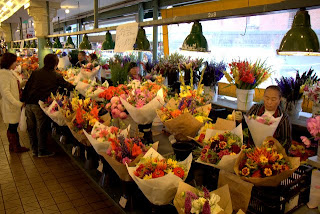
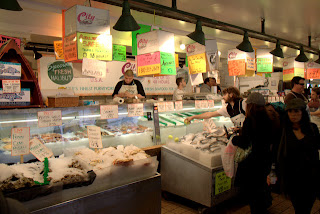
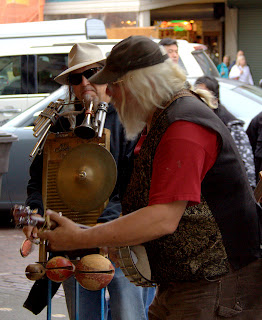


I ate at a Brazilian restaurant, but my body was starting to shut down - it took just one caiparihna, so I returned to the hotel and sleep.

Of course, my body was getting ready to wake up again and at 3 a.m. I ended up doing some work on my presentations, re-organising my luggage etc ready for my early morning ferry to Canada.

Tuesday, 7 September 2010

Andy is travelling again

I’ve decided to resume my blog while on my travels.


I am attending the inaugural World Seabird Conference at Victoria on the island of Vancouver in British Columbia, Canada. I have decided to add on some extra days at the end of the conference to see something of Vancouver Island (it’s supposed to be beautiful, and should be interesting for birds on migration) and also do a quick tour of Washington state over the border in USA.  I’ll finish the trip with a couple of days in Paris, where I’ll meet with George to help him celebrate a significant birthday.  This conference is going to be far from play time, although I hope to enjoy myself as much as I can.  I am presenting a paper to the conference about protected areas at sea for seabirds.  I am also co-organising two different workshops, the first about amalgamating databases for seabird surveys at sea, and the other about combining information from these types of databases with those from satellite tracking studies.  I hope to keep you appraised of what happens over the next 2 ½ weeks.


_____________________________________________________________________
The Joint Nature Conservation Committee (JNCC) is the statutory adviser to Government on UK and international nature conservation, on behalf of the Council for Nature Conservation and the Countryside, the Countryside Council for Wales, Natural England and Scottish Natural Heritage. Its work contributes to maintaining and enriching biological diversity, conserving geological features and sustaining natural systems.

JNCC SUPPORT CO. Registered in England and Wales, company no. 05380206. Registered office: Monkstone House, City Road, Peterborough, Cambridgeshire PE1 1JY


This message has been checked for all known viruses by JNCC delivered through the MessageLabs Virus Control Centre. For further information visit http://www.uk.uu.net/products/security/virus/